
Finding Kalamazoo County Residents
A name, an address, or an old household can all open a Kalamazoo County residents directory search. Match the record to the question first. Parcel data is strongest for a property owner. The state voter tool confirms a registration match. Deeds, court indexes, and library directories each add their own piece of evidence, and each carries its own date and purpose. A hit in one source is a lead worth checking elsewhere, never a full portrait of a person.
No property record lists everyone at an address. The tax mailing address may sit somewhere else entirely. A historical directory can place a person in a household for one publication year, yet it proves nothing about later residence. Whatever a Kalamazoo County residents directory search turns up, save the exact spelling, date, address, and record identifier. That small trail sharpens every search that follows.
- Use Kalamazoo County Parcel Search when an owner, street, or parcel ID is known.
- Test a registration match through the Michigan Voter Information Center with the requested identity fields.
- Search recorded party names in Kalamazoo Deeds Search, then narrow common names by date and parcel.
- For an older household, use Kalamazoo Public Library directories, phone books, and Gazette citations.
- When an online index stops, ask the custodian about its counter, microfilm, copy process, or a focused Michigan FOIA request.
Kalamazoo County Records Offices
Several offices share the record trail here. The County Clerk/Register of Deeds, Equalization staff, and the elections office each keep a different slice of it. When a website lacks an older book, a document image, or a local procedure detail, the counter at 201 W Kalamazoo Avenue is the fallback that still works. The Register of Deeds provides recorded-document access and public workstations, though it will not run title searches or give legal advice. For the most detailed current property card, the municipal assessor for that jurisdiction is often the better stop.
Equalization and parcel access
Room 404, 201 W Kalamazoo Avenue
Kalamazoo, MI 49007
269-384-8112
County elections office
201 W Kalamazoo Avenue
Kalamazoo, MI 49007
269-384-8080
Counter hours run Monday, Tuesday, Thursday, and Friday from 8 to 4:30, with a 9 o'clock opening on Wednesday. A written county request can reach a non-court record that is not online. Court files, however, follow the court clerk's own procedures rather than the ordinary county FOIA route.
Kalamazoo County Parcel Clues
For any owner or address question, the county parcel search is the fastest official start. It takes an owner name, a parcel ID, or any piece of a street. A street name alone can return a property set for the whole block. When spelling is shaky, the county suggests entering just the house number. Read the results as assessment evidence. The assessed owner, physical situs, tax mailing address, parcel ID, and property context all appear. But the output is not a household list.
| Parcel Search field | How it works | Useful caution |
|---|---|---|
| Owner | Any text, including a form such as SMITH J | Names can be abbreviated or held by an entity. |
| Parcel ID | Full or leading ID; punctuation styles are accepted | Parcel numbers can change after splits or combinations. |
| Street | Number and name, name alone, or number alone | A whole-street result shows parcels, not all occupants. |
Useful distinction. A situs address is where the parcel sits. A mailing address is where tax notices go and is not proof that the recipient lives at the property.
Kalamazoo County Deed Index
The Kalamazoo Deeds Search builds a trail by party name. The county reports searchable land-record images back to 1831. A complete index runs from 1984 forward. Search by grantor or grantee first. An address is not required on every recorded document. A common surname demands a date range to separate the unrelated matches. A parcel number or a legal description works too. Basic searching is free, but not every image is free to view or save.
| Name | Optional grantor or grantee field. Test spelling and name order. |
|---|---|
| Date range | Optional pair that narrows a large party-name result. |
| Liber/page or document number | Recorded placement and identifier for a selected item. |
| Parcel number | Useful when shown, though older documents may not use today's parcel ID. |
| Result limit | Results are limited to 500, so narrow broad searches. |
Viewing, printing, or saving document images carries a per-page charge plus processing. The county also provides public workstations. Those matter once a web result hits its cap. They also help when a pre-1984 indexing question needs someone at the counter. Note: a recorded name marks a party to that filing, and not a full account of ownership or residence history.
Kalamazoo County Current Resident Rolls
No single public roll names every current resident of Kalamazoo County. What exists instead is a set of sources. Each is tied to a defined relationship: an assessed owner, a registered voter matching a query, a party to a recorded deed, a court case participant, an estate figure, or a licensed credential holder. Choosing the right source keeps an address or a court result from being mistaken for a biography. When the question centers on one person rather than a place, the Kalamazoo County resident lookup route fits best.
| Local source | What it can confirm | Custodian | Access path |
|---|---|---|---|
| Parcel Search | Assessed owner, parcel, situs and mailing context | County and municipal assessors | Free owner, parcel, or street search |
| Voter Information Center | Registration match and election details | Michigan Secretary of State | Individual lookup; broader file by request |
| Deeds Search | Recorded party and document details | Register of Deeds | Free index, paid images or copies |
| Probate index | Estate, fiduciary, and case trail | Kalamazoo Probate Court | Online index and counter process |
| MiPLUS | Public credential status by profession | Michigan LARA | Free verification |
Michigan Voter Lookup Boundaries
The Michigan Voter Information Center confirms records rather than handing out a neighborhood roll. Its name panel asks for first name, last name, birth month, birth year, and ZIP. Separate license and address panels serve other lookups. A match can show registration status, polling information, a sample ballot, and early-voting details. It will not reveal a full birth date, phone, email, license number, or signature. It also withholds any protected address information.
Going broader takes a written Qualified Voter File request with statutory exclusions attached. The state form allows a defined geographic scope. It delivers by pickup, FTP, or mail, never email. The County Clerk serves as the local election official and can walk through local procedure. Michigan's Address Confidentiality Program substitutes a designated address for eligible participants. So a missing or altered address never supports a conclusion.
Kalamazoo Courts and Probate
Court records answer a different kind of question than a property roll or voter list. Michigan Courts Case Search lets anyone look up selected public cases. Searches run by party name or case number. The results are selective, though. Kalamazoo County's 8th District Court, 9th Circuit Court, and Probate Court each handle different matters. A name that surfaces here is best confirmed with the clerk before it is treated as fact. Plenty of material never shows up at all. Adoption files, most juvenile and protective proceedings, mental-health cases, name changes, and wills stay out of the public search.
Probate is the place to start for estate work. Kalamazoo County probate records go back to 1832. An online index covers 1995 to the present alongside older cases that remain active. Images are not posted, so the index is a pointer rather than the file itself. A case number, a fiduciary's name, and an estate date give the clerk everything needed for a focused counter request. This trail is separate from deeds and voter rolls. For estate administration or an heir question it is often the right records office to visit. Keep in mind that a shared name alone proves no family tie.
Kalamazoo Vital Record Timing
The Kalamazoo County Clerk/Register of Deeds acts as local registrar. Michigan Vital Records handles statewide ordering. The state draws sharp lines between record types. Birth certificates stay restricted for 100 years. Local genealogy viewing opens only after 110 years. Death and marriage records generally go to any applicant who sends a written request and prepays the search fee. Free local genealogy viewing follows after 75 years. Divorce certificates travel their own court and state routes.
The state order page lays out mail, online, phone, drop-box, appointment, and pickup options. Each is tied to that record's eligibility rules. Michigan's vital-record ordering page shows those channels and the instructions for each certificate. County genealogy holdings can serve as a historical access route. A certificate copy is not always the right request.
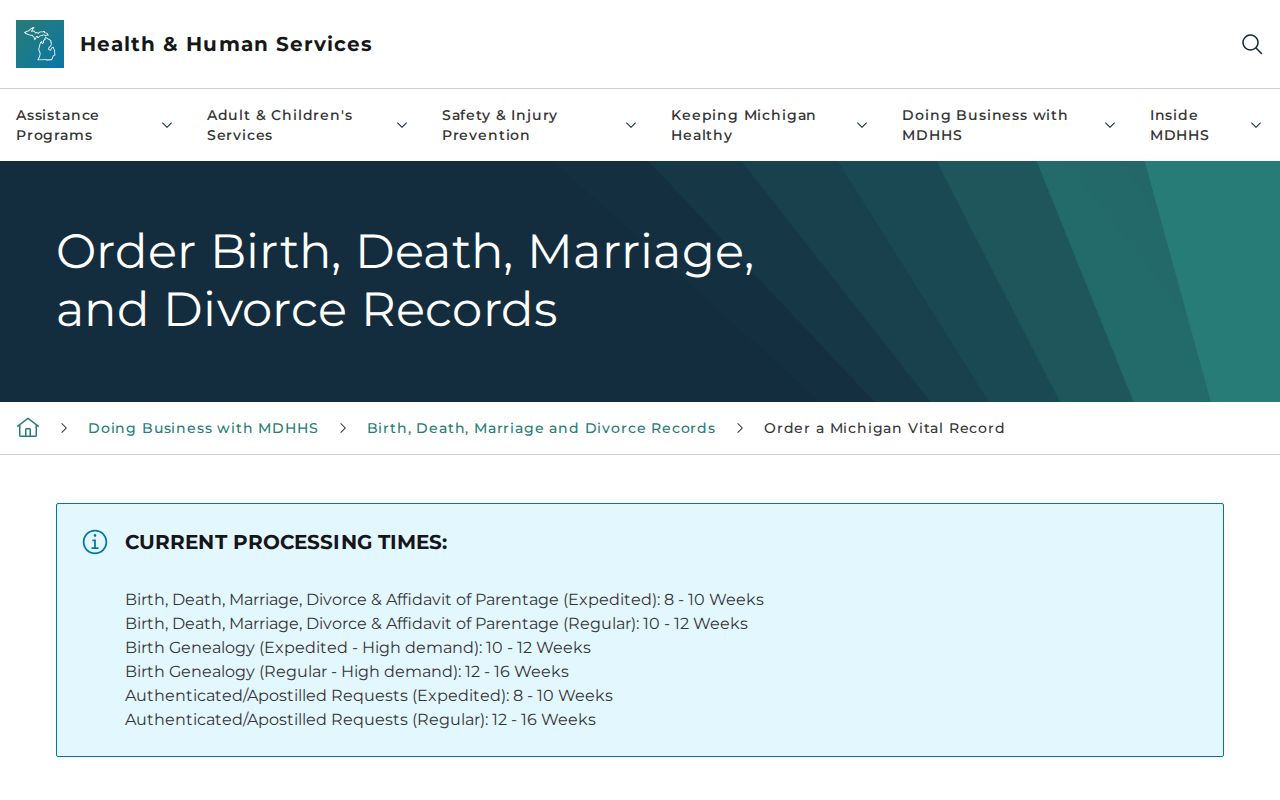
Order through the custodian named for that record, whether county or state. Keep the order date and request type with whatever document arrives.
Kalamazoo County Historical Directories
Old directories are the backbone of Kalamazoo County resident research. The Kalamazoo Public Library Local History Room keeps the county's practical shelf. That shelf holds city directories, phone books, maps, yearbooks, newspapers on microfilm, genealogy material, and local files. Kalamazoo city-directory coverage starts in 1860. Rural directories fill in the rest of the county. They include 1919, 1926 rural-route, and 1969-70 farm volumes. Village and township history does not collapse into the city run because of them. Edition-by-edition detail, entry marks, and reverse volumes sit on the Kalamazoo County city directories page.
A criss-cross directory flips the usual name-first order. An address leads to its listed occupants. KPL's criss-cross coverage begins in 1954. A single directory entry can pin down a historical address, an occupation note, or a household clue for that edition. Pair it with deeds, census releases, Gazette citations, or probate when the question demands stronger proof. Deeds and probate supply the stronger proof some questions demand.
- Roll
- A record list made for a defined purpose, such as assessment or voter registration.
- Index
- A finding list that points to records and may not include the image or full file.
- Parcel
- A mapped unit of land identified for assessment and deed work.
- Criss-cross directory
- A reverse address directory that helps trace listed historical occupants.
Kalamazoo County Archive Fallbacks
A portal that returns nothing is a signal, not a dead end. Move to the repository that holds the source instead of widening a name search blindly. KPL's Local Information Database can produce a Gazette title, date, and page citation. The microfilm then holds the article itself. Western Michigan University's Regional History Collections and ArchivesSpace add personal papers, regional photographs, newspapers, county records, and searchable collection descriptions. The Library of Michigan is one more fallback. It is strong on county guides, maps, newspapers, and census references.
Go in with a plan. Bring a name, a date range, a community, and any identifier already in hand. Ask for a directory call number, a microfilm reel, a finding aid, or an older index series. That request reaches the right shelf far more often. KPL's Meader family sketches and its WWI/WWII collection can surface relatives and service context no parcel card shows. They are historical aids rather than current resident rolls.
Kalamazoo County's record geography also shifts by municipality. One city address can touch a county parcel, a city tax page, a township assessor, and a postal label crossing the municipal line. Record the city, village, or township beside every result. That small note keeps an address trail from drifting between custodians unnoticed.
Kalamazoo County Privacy Limits
Public access in Kalamazoo County has firm boundaries. Property and recorded-document results do not name every household member. Michigan voter rules withhold sensitive fields. The Address Confidentiality Program shields qualifying survivors through a designated address and mail forwarding. Court portals leave out confidential categories. Utility accounts, delivery routes, and DMV address data are not ordinary public resident records. A missing result can mean a restriction. It can also be an indexing gap, a different custodian, or simply a spelling variation.
Every record should be read for the relationship it actually documents. An owner can be a trust, an estate, a business, or someone living elsewhere. A historical directory might list a boarder or an older spelling. A voter confirmation is one record, not a bulk address list. Hold those limits in view. That protects the accuracy of a Kalamazoo County lookup and the privacy of people the public record never represents.
Use records lawfully. Do not use an address, directory entry, or public lookup to stalk, harass, threaten, or expose any person. Confirm sensitive questions with the responsible custodian.
Michigan FOIA, MCL 15.231 et seq., covers requests for existing government records. It does not force a public body to assemble a new person report. Kalamazoo County also treats court records as outside ordinary FOIA handling. The Michigan Attorney General's FOIA reference pairs well with the relevant county or city process. Use both for a focused request.
Michigan License and Business Checks
Michigan runs its own credential verification through MiPLUS. The MiPLUS portal lets anyone check a professional license. Lookups are organized by profession, and public verification is free. A certified verification costs extra as a separate product. Treat any address on file as the state presents it. It reflects a credential address, not a full personal address history for a residents directory search.
Business filings live elsewhere. The MiBusiness Registry took over Michigan entity searching in June 2025. Searches by entity, individual name, ID, or filing number can reveal formal filing roles, though a registered office or agent is not the same as a person's residence in a resident lookup.
Kalamazoo County Records Safety
Scammers have targeted Kalamazoo County record seekers directly. The county warned on March 16, 2026 about fake 8th District Court payment texts. A similar fake-fine warning came in 2025. A text carrying your name or a case number proves nothing about its sender. Type the official court or county address yourself. Compare any phone number against the official page. Refuse to send payment or identity details through an inbound link. The same caution applies to deed-copy offers and unclaimed-property messages.
Before acting, verify any unexpected notice with the named custodian. The Register of Deeds publishes its standard copy charges. Michigan's unclaimed-property search is free. That simple check protects both the records search and the person running it.
One free safeguard is the Register of Deeds Property Fraud Alert signup. It sends a notice whenever a personal or business name appears on a recorded document. It cannot block a deed from being recorded. It also does not replace reviewing the property record yourself. What it does give an owner is a prompt. Call the office if an unfamiliar filing shows up. Treat the alert as a notice service, never as proof of fraud.
Copy solicitations deserve the same skepticism. Compare any offer against the county's stated charge of $1 per page plus a $2.50 technology fee. Ask whether a certified copy is truly needed. A latest-deed lookup by staff, an image charge, a recording fee, and a tax-certificate question are all separate transactions. Calling the Register of Deeds before paying a private sender remains the reliable local check.