
Kalamazoo City Directory Collections
Kalamazoo Public Library's city-directory guide identifies 1860 as the first Kalamazoo directory and says its Local History Room holds every published city volume. The collection is more than a run of name books. It includes city, county, rural, suburban, telephone, and reverse-address material, but each series has its own date span and audience. The library cautions that county coverage is sporadic, and the last county directory appears in the 1919 volume. Use the catalog shelf for the imprint and exact year instead of assuming one publisher covered every volume.
| Local collection | Verified years | Holding location | How to use it |
|---|---|---|---|
| Kalamazoo city directories | First 1860; all published runs held | KPL Local History Room, H 917.7417 K14 | Consult the physical volume and catalog for year-specific detail |
| County and rural directories | County material sporadic; rural 1919; rural route 1926; farm 1969-70 | KPL, with selected links from its guide | Use for communities outside the city run |
| Suburban and phone volumes | Suburban 1966-76; phone books from 1913, reliably complete from 1949 | KPL, including H 917.7417 M624 | Compare address, telephone, and community clues |
| Criss-cross directories | Oldest 1954; Bresser volumes in the 1970s | KPL, H 917.7417 K143 | Read an address in reverse order to find listed occupants |
The gaps matter as much as the volumes. A city volume may skip rural residents, a phone book may not cover every household, and a criss-cross book begins far later than the earliest directory. KPL also links a digitized 1919 rural directory, while its shelves and catalog remain the fallback for a volume that is not online.
KPL's collection page documents the range of city-directory material available through the local-history program.
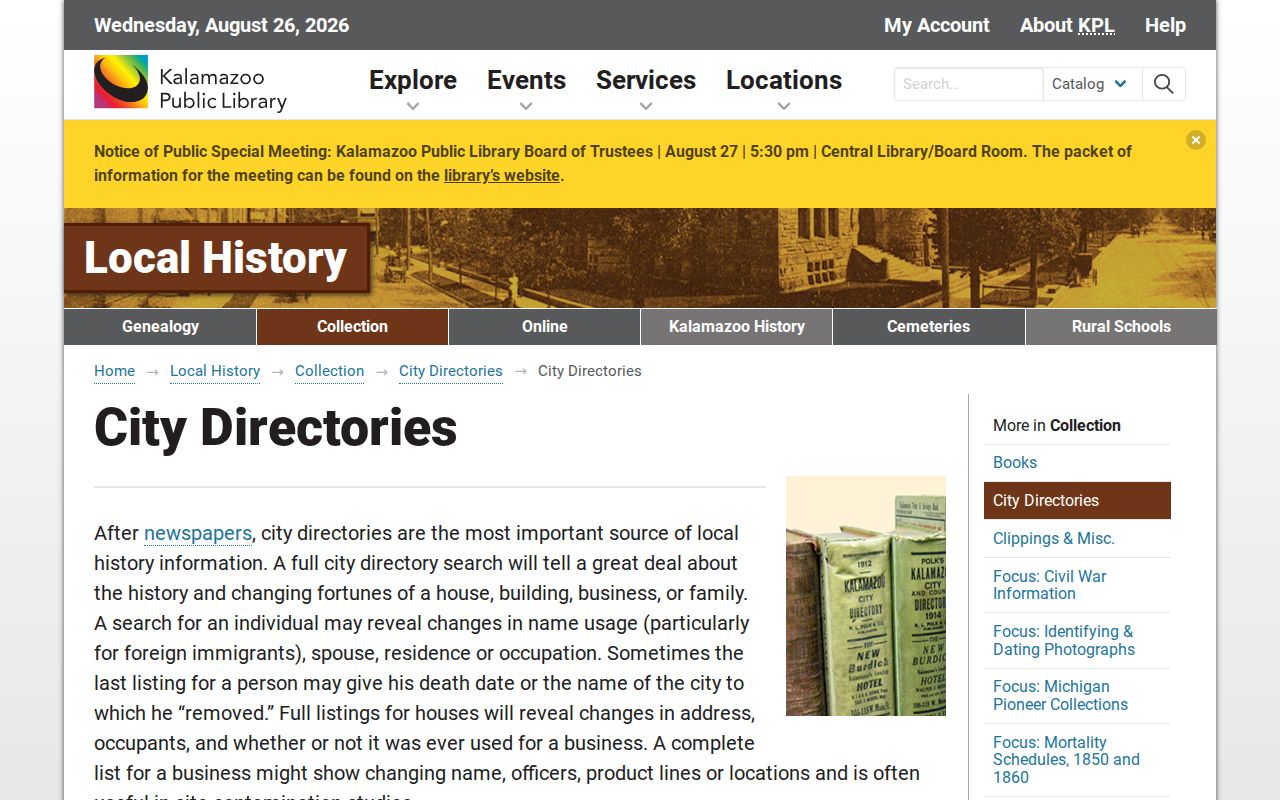
The collection view is a reminder to preserve the cited year and call number with every transcription, especially when two volumes organize names and addresses differently.
KPL's Kalamazoo City Directory Shelf
The Central Library Local History Room provides the main in-person route when an online scan is incomplete or an old spelling needs to be checked on a page. It is on the second floor at 315 S Rose Street, with genealogy, maps, atlases, yearbooks, city directories, phone books, and local newspapers on microfilm. The room's hours are Monday through Thursday from 9 to 8, Friday 9 to 6, Saturday 10 to 5, and Sunday 1 to 5. Its phone number is 269-553-7808. Bring the name variants, the street spelling used in the period, and the year range, rather than asking staff to identify a person from a modern address alone.
The KPL Local History collection also includes the Local Information Database. That database provides names, file references, books, and Kalamazoo Gazette citations, not a full newspaper article. A citation leads next to the identified microfilm or local item. Licensed genealogy databases may be available through the library under its access rules, which is another reason to confirm access before traveling.
KPL's Local History Room is the source for the reading-room collection, staff help, and accompanying research materials.
The room joins the directory shelf to microfilm, map, and yearbook evidence, so an address or name from one volume can be checked without treating it as a complete biography.
Note: Save the volume year, page, call number, and spelling used before leaving the reading room.
Kalamazoo Numbering Bridges
Kalamazoo's address system can make a household appear to vanish when the household did not move. In 1883 the city adopted the Philadelphia numbering system, using Michigan Avenue, then called Main, and Burdick as axes. Before that shift, numbers could be measured from the river and Main Street. Citywide numbering changed again in 1925, but no 1925 volume explains the transition. KPL's house-history method is practical: compare 1924 and 1926, inspect the immediately lower and higher numbers, and then bridge back with a 1922 or earlier directory.
Street names changed too. Michigan Avenue was Main, Cork was St James, Oakland Drive was Asylum, Riverview was Seminary, Vine was Rice, and Westnedge was West north of Lovell and College south. The 1932 Sanborn volume can help connect old and new numbers. This is a locally documented quirk rather than a reason to force a current address onto an older street line.
Modern owner and parcel work belongs to the Kalamazoo by-street directory; the historical volume should establish the address form and year first.
Reading Kalamazoo City Directory Entries
A directory entry is compact evidence. KPL describes a typical line as a person name, residence address, spouse in parentheses after the principal person, occupation, business or employer reference, and shorthand such as res. or bds. The latter means "boards at." Same-surname people at one address may be relatives, while students often appear in the line-up. Women may disappear under a married name and later reappear under a maiden name. Those possibilities should prompt another search, not a conclusion about a household relationship.
| Name position | The older name section is the safest personal index when no reverse address section exists. |
|---|---|
| Residence or office | A line can contain a home address and a separate business location, as the 1869 examples show. |
| Household clue | A spouse in parentheses or a shared surname can suggest a connection that needs confirmation elsewhere. |
| Role and shorthand | res. marks residence or head-of-household context; bds means boards at. |
| Later additions | Phone numbers appear in later runs, and a small o in mid-1930s volumes indicates ownership. |
- Criss-cross directory
- A reverse directory arranged from street address to listed occupant, useful for the local volumes beginning in 1954.
- Householder index
- A name-led arrangement that points to a household entry rather than listing every person who might be present.
- Abbreviation key
- The volume's explanation of shorthand. Read it before expanding a marker in notes.
- OCR
- Machine-read text from a scan. It can misread a name, street, letter, or punctuation mark, so the image controls.
The digitized 1869 Kalamazoo County Directory is a useful example of the older format. Its metadata identifies J. M. Thomas as publisher and describes a 387-page scan. Examples include a student at 50 Seminary, a physician with office and home addresses, and a clerk boarding at 11 Cedar. OCR errors in that volume make the scanned page, not the search snippet, the record to quote.
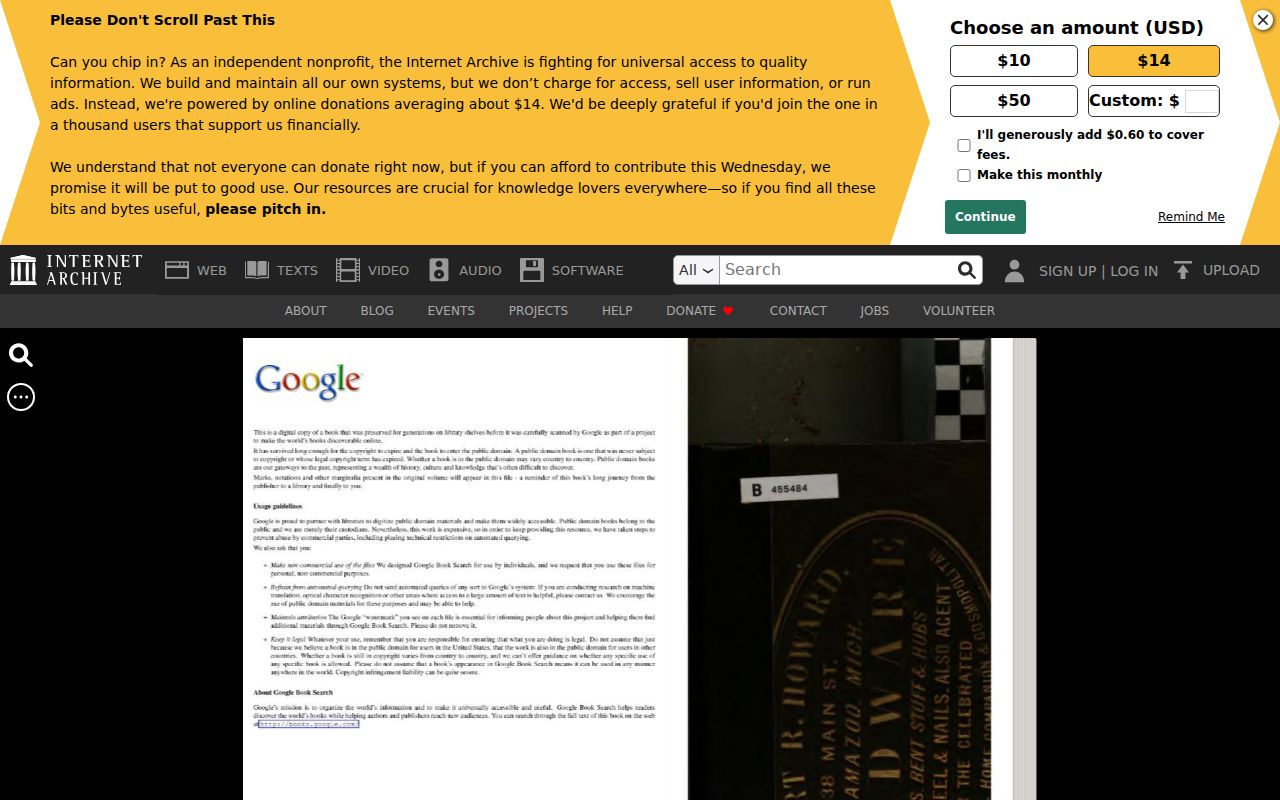
The 1869 scan illustrates why an old volume may show a role, boarding notation, office, and residence in one short line, each requiring a year-specific reading.
Kalamazoo Rural Directory Runs
Historic Kalamazoo County cannot be reduced to the urban run. The 1919 Rural Directory, 1926 Kalamazoo/Van Buren Rural Route volume, and 1969-70 Official Rural Farm Directory give routes, farms, and county names that an urban volume may miss. Suburban volumes cover 1966 through 1976 before being folded into the regular annual volume in 1977. Phone directories began in 1913 and are reliably complete from 1949, offering another address-to-telephone connection when the annual volume is silent.
Yearbooks and student catalogs add a different kind of identity link. KPL holds student-catalog material from 1851 to 1902, and KPL and Western Michigan University hold area yearbook runs. The Meader Collection contains 36 family-sketch volumes, while the local WWI/WWII collection spans 27 volumes and more than 10,000 people. These are historical and family-history sources, not current resident lists.
Note: A city, rural, phone, or school source answers a different question, so retain the collection name beside each result.
Tracing Kalamazoo City Directory Households
Follow one household through the volumes rather than treating a single listing as the final answer. Begin with a confirmed name or address, then watch for moves, spelling shifts, marriages, boarding notation, and name disappearances. Pair annual listings with released federal census years, while remembering that a census and a directory were created for different purposes and at different times. Probate, deeds, Gazette notices, and cemetery or church material can help distinguish a move from a death, but none should be substituted for the source it is testing.
- Start in the directory year nearest the known address or event and transcribe the entry exactly, including abbreviations.
- Move one year at a time in both directions, noting street form, residence, occupation reference, spouse notation, and any phone or ownership marker.
- When a name disappears, check one more year, variant spellings, a married or maiden name, and the immediately adjacent street numbers.
- Use the criss-cross section after 1954 to test the address-to-occupant connection, then compare an applicable census release or Gazette citation.
- Take the citation, volume year, and page to KPL, WMU, Probate Court, or the Register of Deeds when a primary record is needed.
A disappearance can mean a move, death, unlisted status, a spelling change, or an indexing gap. The strongest result preserves that uncertainty until two independent sources share the same address, name form, date range, or family connection. A historical listing that needs a current official check can be carried to the Kalamazoo resident lookup workflow without assuming continuity across decades.
Kalamazoo Gazette Citation Trail
KPL's Gazette run is almost complete from 1834 to the present, and its clipping files are strongest from 1928 through 1968. Search the Local Information Database for a person or subject, record the Gazette title, date, and page citation, then locate the item on microfilm. A flash drive is useful for scans. This citation-first route avoids treating a database reference as the full newspaper text.
The Library of Michigan Kalamazoo County guide adds Parchment News, Portage Herald, Vicksburg Commercial, Augusta Beacon, maps, census indexes, veterans material, and a foreign-deaths index. When KPL lacks a year, WMU ArchivesSpace can be searched by keyword, field, record type, and year before requesting a collection. These are the principal archive and microfilm channels after a directory shelf or scan fails.
Kalamazoo Directory Timeline
The local directory chronology explains which tool can answer an address question. It also shows why a missing year must be documented instead of guessed around.
| 1860 | First Kalamazoo directory identified by KPL. |
|---|---|
| 1883 | Philadelphia numbering system adopted, with Main and Burdick as axes. |
| 1897 | First street-order section appears. |
| 1925 | Citywide renumbering occurs, but no directory is available for that year. |
| 1954 | Oldest KPL criss-cross directory begins the local reverse-address trail. |
Later collections, including suburban and phone runs, extend the shelf in different directions. Keep the historical street system and the exact volume year in every citation.